
Polyandrous science
March 2026

Science, especially ‘bee’ science, has a fortuitous and many-fathered ancestry. In the summer months of 1974 an article published and discussed in the British magazine ‘Wireless World’ inspired an idea that would begin to fill in some of the gaps in our knowledge about honey bees, but was initially proposed as a life-saving safety measure.1 It described technology developed by a group of Radio Corporation of America (RCA) Lab engineers from Princeton that was designed to prevent rear end collisions on highways, at the time a third of all vehicle accidents2. It was a radar technology that may have its descendants in your car today.
The problem with using a reflected signal from radar is that you need a clear space to operate in; easy if you are a ship or an aeroplane, not so easy if you are among a ‘clutter’ of reflecting objects on the ground. The RCA team’s solution was what we now call ‘harmonic’ radar’, which detected the presence of a returned harmonic of the broadcast signal rather than the reflected signal itself. By fitting the object you are interested in with a tiny unpowered device that only had to radiate a harmonic of the signal it received, in coming years tiny, unpowered, harmonic radar devices would be small and portable enough to be used to detect avalanche victims, hornets3, and even track beetles.4 You just had to be able to ‘hit’ them with the beam from a radar transmitter.
Seeing harmony
In 1996 a group of researchers from the UK’s Institute of Arable and Crop Research (IACR) and the Ministry of Defence Radar Research group had combined to form a radar entomology unit for the University of Greenwich’s Natural Resources Institute. The group was originally set up to help governments of developing countries to study highly mobile and agriculturally devastating insect pests like locusts and army-worm moths. In a letter to the journal Nature5 they described the use of harmonic radar to follow bees from three bumble bee colonies and a small hive of honey bees.
The receiving tags used weighed around 3mg, 1.5% the weight of a bumble bee. It increased aerodynamic drag by about 3% but didn’t appear to affect the animal’s behaviour to any degree. The tags operated over a range up to about 700m with radar coverage between a few centimetres off the ground up to 3m. It wasn’t the first time radar had been used to follow bees, but earlier attempts had been constrained by the clutter that harmonic radar could avoid. For the first time we could now follow individual bees as they flew about their daily business.
Prevailing wisdom
One the things about bees that we’ve never properly resolved, despite the assumptions we make, is where queens mate. The wisdom that prevails is that mating only occurs in a persistent, defined space we call a Drone Congregation Area (DCA) and perhaps it does, but a recent paper in Apidologie that reviewed over 200 science papers on the topic reminds us that, actually, this isn’t something we know, it’s something we believe.6 Studies using harmonic radar to follow drones and queens seemed to be the best response to answering many of the open questions about this idea.
The best evidence we have for queen mating in DCAs is the argument that it ‘ought’ to be true; it just makes sense. We hear drones that aggregate, or ‘congregate’ in certain areas, and some queens have been seen to mate there, although not always.7 By congregating drones make themselves easy for a queen to find and, like schooling fish, reduce their individual exposure to predation. By making finding an appropriate mate easy the behaviour limits the risks inherent in a queen’s solitary mating flight.
Open questions
The discovery of the queen pheromone (9-ODA8) that would attract drones in flight was used to survey landscapes for DCAs, and nearly all the research showing the existence of DCAs and queen mating relied on lofting 9-ODA lures or queens using poles, kites, or balloons to attract drones. The fact that the ‘bait’ itself might also stimulate the formation of a DCA called for a method that could independently study the formation of these areas. The early studies used conventional radar, but had to operate in relatively featureless landscapes where DCAs do not readily form. There has been evidence of bees happily occupying spaces like semi-desert or marshland where no DCA has ever been found, which casts doubt on the ‘essential’ nature of DCAs.9
There are also explanations required about how drones (and queens) find a DCA. There can be no permanent intergenerational ‘knowledge’ of these spaces passed on, they must each be discovered by every individual drone rather than being learned from each other. Their orientation flights typically do not take them far enough from their hive to discover congregations, yet after a few local orientation flights fixing their home bearing they magically fly off to one of several DCAs.
It’s difficult to see how dones might recognise a DCA by its common features, not just because we haven’t been able to discern what these are, but also because each shared location would look/feel/smell different for the many thousands of drones that must visit. For example, a particular horizon or feature location will appear differently for drones that approach from the east, compared to the ones originating from a hive in the west.
A little knowledge...
There have been very few radar-traced honey bee studies,10 11 perhaps we are too obsessed with parasites and disease, but it looks like we should be thinking of drone congregations as an emergent feature of behaviour, rather than some physical phenomenon. Joseph Woodgate from Queen Mary College in London has been tracking the routes of bumble bees,12 13 but in 2021 applied the experience to drones, and unsuccessfully, to queens.14
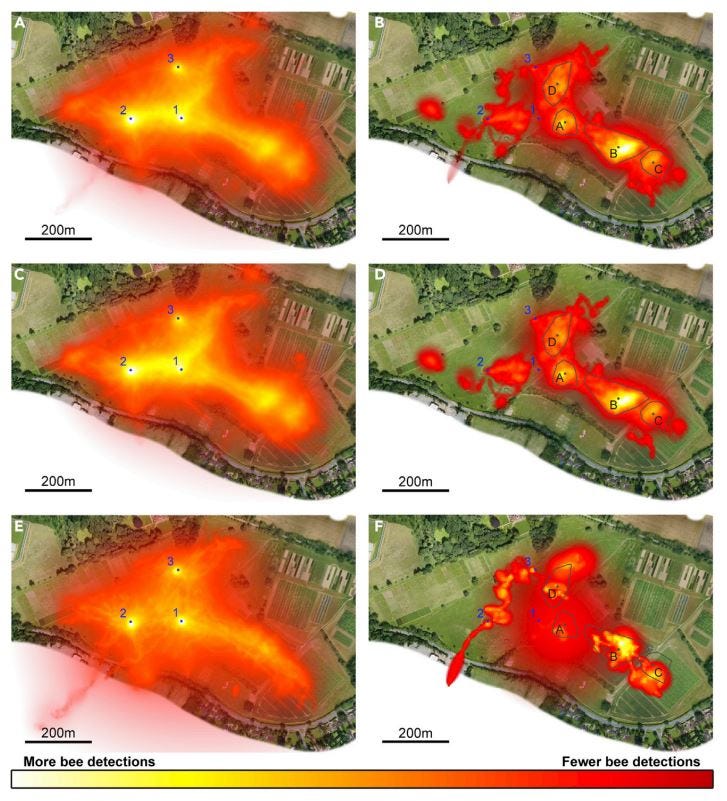
The radars have documented drones moving through the landscape along ‘flyways’; corridors constrained by the physical geography of the site that funnel all the drones from the different local hives onto the same path. These are more or less fixed, year on year, but may shift, perhaps because of unusual wind conditions for example, and they many be the result of all drones using the same set of navigational strategies rather than any ‘knowledge’.
Earlier studies could only ‘see’ clouds of drones. Harmonic radar revealed the track of individual drones on sections of straight flight, each interrupted by sudden episodes of much more ‘convoluted’ flight. The later behaviour was described in terms of a ‘swarming’ flight, where bees move away from a point, then accelerated back to that point with a speed that was proportional to the distance they had travelled. The mating swarms of midges and mosquitoes are another example where this is seen. This is typical of lots of ‘swarming’ animals, the sudden bouts of acceleration are part of what keeps a swarm together. The drones would circulate through several DCAs in a single flight using the flyways, stopping for a minute or two to perform these convoluted flights and then move on. The places where the convoluted flights of hundreds of drones happen to coincide are an artefact emerging from the drone flyways, and these are what we are calling DCAs.
The Woodgate team’s effort to track virgin queens was unfortunately not very successful, even harmonic radar has limitations. Over three years, out of 94 tagged, there were 26 traces of queens flying, all but three too short for mating flights. Only two returned with mating signs but the longer flights could not be completely tracked. One was not likely to have been close to a (known) DCA and was thought to have mated near a hive; the other flew off towards a DCA but dislodged its tag. It wasn’t clear whether queens also use the same flyways, but it seems a stretch to claim queens only mate in DCAs.
Where queens actually mate is something we could do with knowing more about, partly because we could improve the commercial utility of our queens, but it also has important implications for conservation, where the reproductive isolation of bee strains matters. Microelectronics and battery technologies are now sufficiently developed to enable tiny radio transmitters, small enough to be carried by an insect the size of a bee, and producing a signal powerful enough to be detected kilometres away. These seem to be the next logical step15. Maybe there will be some redundant radio tracking gear available in Auckland soon,16 and we can find out more...
An edited version of this article appeared in the Apiarist’s Advocate, March 2026. Read more of the Advocate here.
Radar for cars, clutter-free, J. Shefer, R. J. Klensch, G.Kaplan & H. C. Johnson, Wireless World, p117 May, p199 June (1974)
J. Shefer;R. J. Klensch, Harmonic radar helps autos avoid collisions, IEEE Spectrum (1973) Vol: 10, Iss: 5
Lioy, S., Laurino, D., Maggiora, R., Milanesio, D., Saccani, M., Mazzoglio, P.J., Manino, A., Porporato, M., 2021. Tracking the invasive hornet Vespa velutina in complex environments by means of a harmonic radar. Sci Rep 11, 12143. https://doi.org/10.1038/s41598-021-91541-4
Mascanzoni, D., Wallin, H., 1986. The harmonic radar: a new method of tracing insects in the field. Ecological Entomology 11, 387–390. https://doi.org/10.1111/j.1365-2311.1986.tb00317.x
Riley, J.R., Smith, A.D., Reynolds, D.R., Edwards, A.S., Osborne, J.L., Williams, I.H., Carreck, N.L., Poppy, G.M., 1996. Tracking bees with harmonic radar. Nature 379, 29–30. https://doi.org/10.1038/379029b0
Otis, G.W., 2026. Where do honey bees (Apis mellifera) mate? Apidologie 57, 3. https://doi.org/10.1007/s13592-025-01237-1
Doolittle, G.M., 1889. Scientific queen-rearing as practically applied. Chicago. https://doi.org/10.5962/t.173039
“My first plan was to take Virgin Queens, from eight to ten days old, into the fields to places where I believed that drones congregated, by the loud roaring which I heard in high altitudes, between the hours of 1 and 3 o’clock p.m. I would then let them out of the wire-cloth cages which I had carried them in, leaving each one in a separate place, near some old stump or stone, from which they could mark the location of their cage. The Queens would mark the place from which they went, the same as they would when coming from a hive, circling farther and farther, till lost from sight, some of them being gone a long time (long enough to meet a drone), when they would return and re-enter the cage, and if I was on hand, they could he easily secured again; but I have to report only failure along this line...
My next plan was to take a very few young bees and a little piece of comb in these cages, but with this I was no more successful. Why no Queen should ever come back under such circumstances, bearing the marks of fertilization, is more than I can understand, yet such has always been the case”
9ODA - 9-oxodecenoic acid
Butler, C.G., Fairey, E.M., 1964. Pheromones of the Honeybee: Biological Studies of the Mandibular Gland Secretion of the Queen. Journal of Apicultural Research 3, 65–76. https://doi.org/10.1080/00218839.1964.11100085
Loper, G.M., Wolf, W.W., Taylor Jr., O.R., 1987. Detection and monitoring of honeybee drone congregation areas by radar. Apidologie 18, 163–172. https://doi.org/10.1051/apido:19870206
Loper, G.M., Wolf, W.W., Taylor, O.R., 1992. Honey Bee Drone Flyways and Congregation Areas: Radar Observations. Journal of the Kansas Entomological Society 65, 223–230
Woodgate, J.L., Makinson, J.C., Lim, K.S., Reynolds, A.M., Chittka, L., 2016. Life-Long Radar Tracking of Bumblebees. PLoS ONE 11, e0160333. https://doi.org/10.1371/journal.pone.0160333
Woodgate, J.L., Makinson, J.C., Lim, K.S., Reynolds, A.M., Chittka, L., 2017. Continuous Radar Tracking Illustrates the Development of Multi-destination Routes of Bumblebees. Sci Rep 7, 17323. https://doi.org/10.1038/s41598-017-17553-1
Woodgate, J.L., Makinson, J.C., Rossi, N., Lim, K.S., Reynolds, A.M., Rawlings, C.J., Chittka, L., 2021. Harmonic radar tracking reveals that honeybee drones navigate between multiple aerial leks. iScience 24, 102499. https://doi.org/10.1016/j.isci.2021.102499
Kennedy, P.J., Ford, S.M., Poidatz, J., Thiéry, D., Osborne, J.L., 2018. Searching for nests of the invasive Asian hornet (Vespa velutina) using radio-telemetry. Commun Biol 1, 88. https://doi.org/10.1038/s42003-018-0092-9
Following advice from the UK about NZ’s hornet incursion (2025) in Auckland the response team obtained radio telemetry equipment produced by Robor Nature, part of Robor Electronics BV, who specialise in drone technology and wireless communication systems. Located at Bentelo (in the southern part of the Netherlands) they supply complete micro-transmitter kits which, when deployed by a drone (the UAV kind!), have an effective range of 2km. This is used with their Vespa Finder app, or, in the UK, the Asian Hornet Watch app. The ‘tag’ carried by the hornet weighs less than 160mg, about 100mg less than those used by Kennedy et al (ibid).